
3 Days in Tbilisi: Wine, Sulfur Baths, and the Silk Road
June 8, 2026
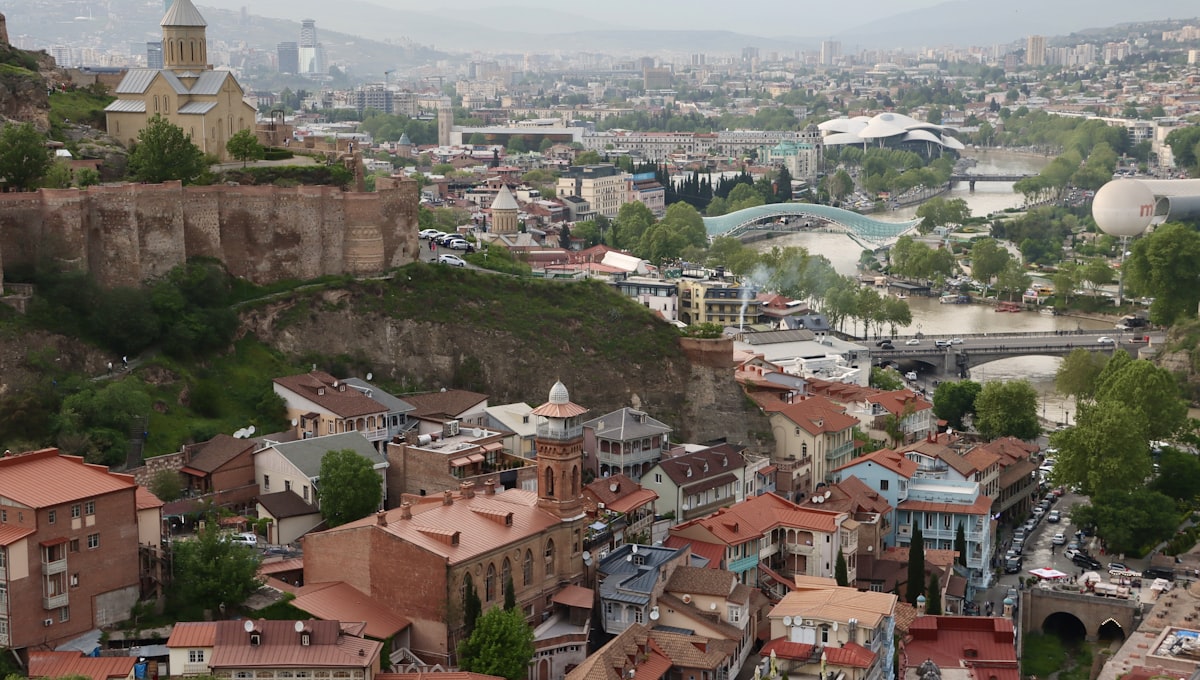
Tbilisi arrived on the European city break radar slowly and then all at once. For years it was a destination known mainly to long-term backpackers and wine enthusiasts who'd found their way to the country's extraordinary qvevri amber wines. Then boutique hotels started opening in the old town's carved wooden balconied houses, a natural wine bar scene emerged that rivalled anything in Paris or London, and flights from Western Europe became genuinely cheap. The city is now at a perfect inflection point: internationally known enough to have good infrastructure and English-language accessibility, not yet crowded enough to have lost its character or its prices.
Getting There
Tbilisi International Airport (TBS) is served from London Gatwick (LGW) by Wizz Air at prices that regularly drop to £80–£130 return, making it one of the cheapest substantive long-haul destinations accessible from the UK. Georgian Airways (A9) connects from Vienna, Amsterdam, Berlin, and several other European cities, with prices that vary more widely. Turkish Airlines (TK) connects from Istanbul (IST) with convenient timings that work well for travellers routing via the Gulf from Asia or Africa. From the Middle East, flydubai (FZ) from Dubai and Air Arabia (G9) from Sharjah provide cheap connections at £70–£120 return.
The flight time from London to Tbilisi is 4 hours 30 minutes. That's short enough to be genuinely a long weekend without sacrificing a meaningful travel day to transit, and long enough that the destination feels properly foreign rather than just continental. The combination of distance, price, and genuine otherness makes Tbilisi one of the best European weekend break values currently available.
Georgia's visa policy is exceptionally liberal. EU, UK, US, and most Western passport holders are permitted stays of up to 365 days without any visa application or documentation beyond a valid passport. The 365-day rule is real, not a misprint — Georgia operates one of the world's most open entry policies as a deliberate strategy to encourage tourism and long-stay visitors.
Day One: Old Town, the Narikala Fortress, and the Sulfur Baths
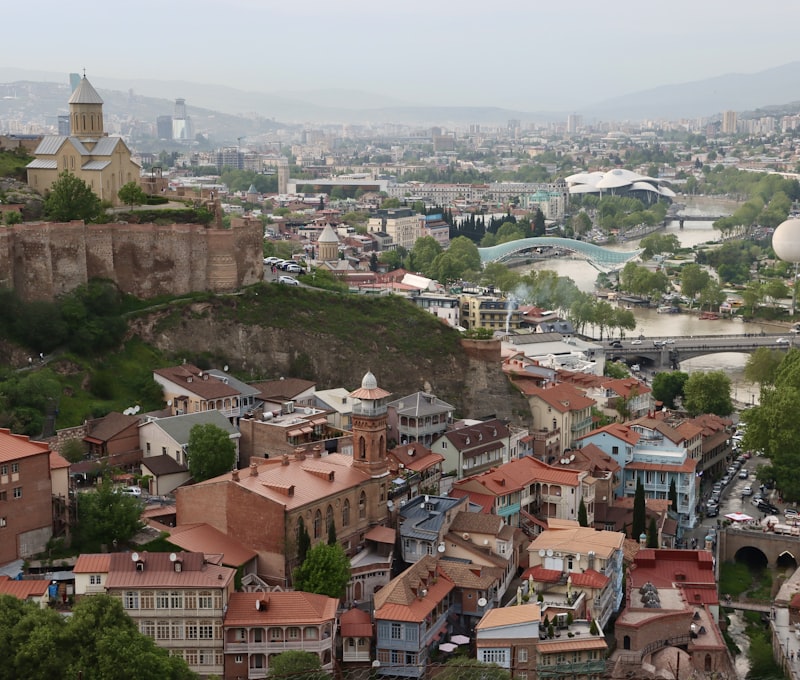
Begin in Abanotubani — the sulfurous old bath district on the east bank of the Mtkvari River, beneath the Narikala Fortress. Tbilisi's founding legend is worth knowing before you arrive: in the 5th century, a Georgian king named Vakhtang I was hunting in the valley when his falcon caught a pheasant and both fell into a hot spring. When retrieved, the pheasant was cooked. The king, recognising the thermal springs as a resource, built his capital around them. The name Tbilisi derives from the Old Georgian word for warm, referring to these same springs that are still flowing and still powering the sulfurous public baths today.
A private bath session at Orbeliani Baths (the domed building with a Persian-influenced facade visible from the main road) or Chreli-Abano runs ₾30–₾60 (approximately €10–€20) for a one-hour session including a traditional kese body scrub using a coarse mitt that removes dead skin with considerable enthusiasm. Book ahead for the private rooms — each has its own pool fed by the sulfurous spring water, a wooden changing room, and a basic shower. The public section is cheaper at around ₾5 entry but is communal. The sulfur smell dissipates quickly and the warmth of the water at 37–39°C is genuinely therapeutic after a long flight.
From Abanotubani, walk uphill through the old town and past the Persian-era Metekhi Church — perched on a cliff above the river — to the Narikala Fortress, a 4th-century citadel that has been rebuilt and partially destroyed by successive empires across 1,600 years. The fortress walls still stand to impressive height on the cliff above the city. Within the complex is the Kartlis Deda statue — a 20-metre aluminium figure of a Georgian woman holding a sword in one hand (for enemies) and a wine bowl in the other (for guests), which functions as the city's informal emblem. The cable car from Rike Park on the river bank runs to the fortress in under five minutes and costs ₾2.50 (less than €1). Take it up; walk back down through the old town.
The old town (Dzveli Tbilisi) immediately below Narikala is Tbilisi's most photogenic and historically layered district. The wooden carved balconies — overhanging the narrow lanes, draped with wisteria in May and June — date mainly from the 18th and 19th centuries. The Persian, Ottoman, and Russian influences are all visible in the architectural details. Walk through the Meidan (main square of the old city), past the Sioni Cathedral (6th century, rebuilt multiple times), and the Anchiskhati Basilica — the oldest surviving church in Tbilisi, built in the 6th century and functioning as an active parish today with services conducted in Georgian, a liturgical language with an alphabet unlike any other on Earth.
Dinner on night one: Café Littera in the garden of the Georgian Writers' Union on Machabeli Street. This is widely considered Tbilisi's finest restaurant — modern Georgian cuisine using local seasonal ingredients — operating in a setting of jasmine-covered pergolas, candlelight, and a garden that feels transplanted from a Tbilisi of a hundred years ago. The food — chicken in walnut sauce (satsivi), roasted aubergine with garlic and walnuts (nigvziani badrijani), and slow-cooked lamb served on clay plates — would cost three or four times as much in any equivalent London or Paris restaurant. A full dinner for two with wine runs ₾240–₾360 (€80–€120 for two).
Day Two: Wine, Mtatsminda, and Fabrika
Georgian wine is not like anything else available in European wine lists. The country argues convincingly — with archaeological evidence — that wine was first cultivated in the South Caucasus approximately 8,000 years ago. The traditional qvevri method involves fermenting wine in large egg-shaped clay vessels buried underground, with white grapes often left in contact with their skins and seeds for weeks or months. The result is amber wines (sometimes called orange wines in Western wine vocabularies) with tannic structure, oxidative notes of dried apricot and walnut, and a complexity that rewards multiple glasses across an evening rather than a single tasting.
The best Tbilisi introduction to this world is Vino Underground on Galaktion Tabidze Street, a wine bar operating as a collective for Georgian natural wine producers including the Alaverdi Monastery winery, Iago Bitarishvili (whose Chinuri is consistently extraordinary), and several small-production family estates from the Kakheti wine region. The list runs to dozens of qvevri wines by the glass, served alongside churchkhela (the national sweet — walnuts strung on a thread and dipped repeatedly in grape juice concentrate until a dense coating forms) and a cheese board. A comprehensive two-hour tasting costs ₾60–₾80 per person (€20–€27). Come in the early evening before 8pm when it's quieter.
The afternoon on day two is for Mtatsminda, the forested hill rising above the city's west side to 770 metres. The historic funicular from Chonkadze Street has operated since 1905 and was restored in 2012; the ride costs ₾3 (€1) and takes about eight minutes through dense pine and chestnut forest to the summit. The view from Mtatsminda across Tbilisi — the river, the old town rooftops, the Narikala Fortress, and on clear days the Greater Caucasus mountains on the horizon — is the best in the city. The Pantheon of Georgian Writers and Public Figures, a cemetery terraced into the hillside just below the funicular's upper station, contains the graves of Ilya Chavchavadze (Georgia's national poet), the writer Ilia Nakashidze, and various other figures important to Georgian cultural history. It's peaceful, shaded by old trees, and makes for an unusual and genuinely moving afternoon walk.
Evening is best spent in the Fabrika complex on Kostava Street, a repurposed Soviet sewing factory converted into an outdoor social space with independent bars, restaurants, food vendors, a record shop, a skateboard ramp, concept stores, and live music on weekends. The crowd is genuinely mixed — young Georgians, expat residents working in Tbilisi, digital nomads on the 365-day visa, and tourists — in proportions that feel balanced rather than tourist-dominated. Dinner from one of the Fabrika food vendors — Georgian dumplings (khinkali), cheese bread (khachapuri adjaruli), or grilled meat skewers (mtsvadi) — costs ₾25–₾40 per person (€8–€13).
Day Three: Mtskheta Day Trip and Departure
Mtskheta, Georgia's ancient capital, sits 20 km north of Tbilisi at the confluence of the Mtkvari and Aragvi rivers. It's reachable by marshrutka (shared minibus) from Didube bus station in approximately 30 minutes for ₾1 (€0.35) — one of travel's great bargain journeys. The town holds two UNESCO World Heritage monuments.
The Jvari Monastery, perched on a cliff 500 metres above the confluence of the two rivers, was built in the early 7th century and is one of the finest examples of early medieval Georgian ecclesiastical architecture. The view from the monastery forecourt — looking down at the meeting of the two rivers, the red rooftops of Mtskheta below, and the Georgian Military Highway disappearing north toward the Caucasus — is one of the most satisfying in the region. The walk up from town takes 30–45 minutes on a steep path; a taxi from Mtskheta's central square costs around ₾10.
The Svetitskhoveli Cathedral in Mtskheta town centre dates from the 11th century and is the mother church of the Georgian Orthodox faith — the burial site, according to Georgian tradition, of the robe of Christ, brought to Georgia by a Jewish man from Mtskheta who witnessed the crucifixion. The cathedral is an active place of worship and the interior — massive stone columns, ancient frescoes, and a replica of the Holy Sepulchre in one corner — is genuinely extraordinary. Entry is free.
Allow three hours for the full Mtskheta visit including the Jvari climb and return to the town. Catch a marshrutka back to Tbilisi from the main road junction and spend the final afternoon in the city walking Rustaveli Avenue — the city's main cultural boulevard — before the airport.
Budget Reality Check
Tbilisi is inexpensive by European standards in a way that's become rare in cities with genuine cultural substance. A well-located boutique hotel in the old town or near Rustaveli Avenue runs ₾150–₾300 per night (€50–€100). Restaurant meals at quality establishments — not street food, but properly cooked Georgian cuisine at places like Café Littera or Barbarestan — cost ₾40–₾80 per person with wine. The metro costs ₾1 per ride; taxis via the Bolt app run ₾5–₾12 for most city centre journeys.
A three-day Tbilisi trip including return flights from London (on Wizz Air at the typical £90–£120 fare), two nights in a mid-range boutique hotel, all meals, wine tastings, entry to the baths, and the Mtskheta day trip can be comfortably completed for €600–€800 per person. Against Amsterdam, Copenhagen, or Paris at two to three times the price for a comparable experience, Tbilisi's value proposition is almost unfair.
 3 Days in Marrakech: Riads, Souks, and the Atlas Mountains
 3 Days in Dubrovnik: Old Town, Islands, and the Best Sunset Spots