

How Free Stopovers Turn One Trip Into Two
June 3, 2026
A stopover is fundamentally different from a layover. A layover is a connection — you're stuck in an airport for a few hours, moving between gates, eating expensive terminal food, waiting for the next segment. A stopover is a deliberate break in journey, sometimes for days, in a city you actually want to visit. The distinction matters because several airlines have formalised this into genuine programmes that allow you to stop in their hub city for extended periods — sometimes up to a week — at no additional airfare cost. You get two destinations for the price of one long-haul ticket.
This isn't a frequent flyer programme trick or a workaround that requires complex status games. It's a published airline product, openly marketed, designed to make carriers' hub cities more attractive as destinations in their own right. If you understand which airlines offer it and how to book it correctly, you can add an entire city — Reykjavik, Doha, Singapore, Helsinki — to a trip you were already planning to take.
Iceland and Icelandair's Stopover Programme
Icelandair's stopover programme is the most famous and arguably the most generous of any airline in the world. If you're flying between North America and Europe in either direction, all Icelandair transatlantic routes pass through Reykjavik Keflavik (KEF). The programme allows you to stop in Iceland for up to seven nights at no additional airfare cost beyond your existing through ticket fare.
In concrete terms: you're flying New York JFK to London Heathrow on Icelandair for $750 return. Icelandair allows you to spend up to a week in Iceland on the outbound leg, the return leg, or both, without charging a fare premium. You pay for your Reykjavik accommodation and activities — the flights cost exactly what they would have cost for a through connection.

Iceland has enough to fill a full week. The Golden Circle (Þingvellir National Park, Geysir geothermal area, and Gullfoss waterfall) is the most accessible day trip from Reykjavik. The Snæfellsnes Peninsula is a 2.5-hour drive west and feels genuinely remote. Glacier hiking on Sólheimajökull or Skaftafell glaciers (the latter inside Vatnajökull National Park) takes a full day and is guided — non-negotiable for safety. Whale watching from Húsavík is the best in Europe, running May–August. The northern lights are November–March and require getting away from Reykjavik's light pollution. Even two to three days in Reykjavik city itself yields hot-spring experiences at Sky Lagoon (12km from the old town) or the Blue Lagoon (45 minutes from KEF, advisable to book immediately before flying out or after flying in), excellent fish restaurants on the harbour (Fiskfélagið consistently tops lists; Matur og Drykkur does the best hákarl-and-skyr tasting experience), and a compact old town that's walkable in a long afternoon.
The stopover is bookable directly on Icelandair's website. You construct a multi-city flights itinerary: New York → Reykjavik (outbound leg, arriving date X), then Reykjavik → London (second leg, departing date X+3 or X+7). The website's flexible booking engine presents this as a single through fare. It's remarkably intuitive once you know the mechanism exists.
Qatar Airways and the Doha Stopover
Qatar Airways operates a similar programme via Hamad International Airport in Doha (DOH). On most long-haul itineraries that route through Doha, you can request a stopover for up to four days under the Discover Qatar programme. Qatar provides promotional hotel discounts through partnerships with Doha hotels at preferential rates for stopover passengers — typically 20–30% below standard room rates — and the airline's premium positioning makes this particularly attractive for business or premium economy travellers who are already spending a meaningful amount on the base fare.
Doha has developed substantially as a tourist destination, particularly following the infrastructure built for the 2022 FIFA World Cup. The Museum of Islamic Art on the Doha Corniche is genuinely world-class — the IM Pei-designed building and the collection inside are both extraordinary. The National Museum of Qatar is also excellent, with a striking design by Jean Nouvel. The Souq Waqif is one of the most authentic covered markets in the Gulf — better than Dubai's Souq Madinat for genuine character. Desert safari experiences (dune-bashing in a 4WD, camel riding, Bedouin camp dinner) are commercially managed but genuinely fun for first-time visitors to the Gulf. Doha isn't a city that demands a week, but two to three well-planned days is genuinely worthwhile rather than a token experience.
Book the Qatar stopover via the airline's website or through a full-service travel agent. Note that the four-day limit, hotel discount partnerships, and exact terms vary by season and route; check the Qatar Airways stopover programme page directly before booking for current conditions.
Singapore Airlines and Singapore
Singapore Airlines routes a large share of European and North American passengers through Changi Airport (SIN), consistently rated the world's best airport for eight years running. For long-haul itineraries connecting through Singapore, a stopover of 1–3 days can be added to the booking for most itineraries.
Singapore as a stopover destination is arguably the strongest of all the options discussed here, for several reasons simultaneously. Changi Airport itself is worth half a day: the Jewel Changi complex (a glass dome enclosing a 40-metre indoor waterfall, the world's tallest indoor waterfall, surrounded by retail, gardens, and a butterfly garden) is extraordinary by any standard. The city beyond is spotlessly efficient, safe by any international measure, linguistically straightforward for English speakers, and astonishing for food: hawker centres like Maxwell Food Centre, Lau Pa Sat, and Old Airport Road food centre operate from 6 AM to midnight with dishes at S$4–$12 (€3–€9) that would cost £15–£25 in a London restaurant. Laksa, chicken rice, char kway teow, bak kut teh — the breadth and quality of Singapore street food is unmatched anywhere in Southeast Asia.
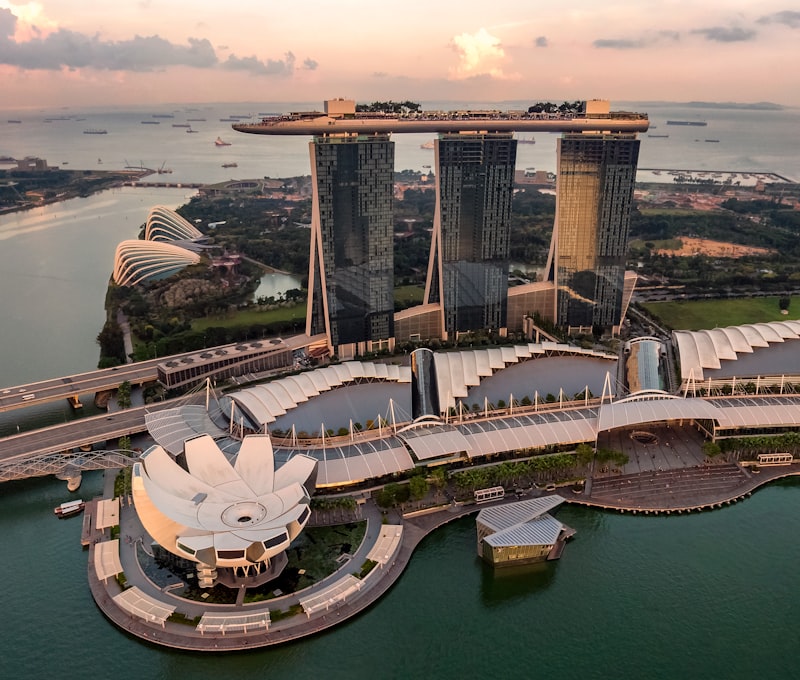
Singapore's National Museum provides essential context on the city-state's remarkable 60-year transformation from a British colonial port to one of the wealthiest countries on earth. The Gardens by the Bay Supertrees are best at night when the light show runs. The infinity pool at Marina Bay Sands (the deck is accessible to non-guests for a fee, the pool itself requires hotel residence) offers the defining Singapore skyline view. A three-day Singapore stopover is genuinely dense and rewarding.
Singapore Airlines' pricing is generally premium, but the stopover mechanism means you're not adding Singapore to your travel budget — it's an existing waypoint. For a Europe–Australia itinerary via Singapore, the stopover means adding S$200–$400 in accommodation for three nights and your food costs, but not a separate London–Singapore–London airfare that would run £600–£900.
Finnair and Helsinki
Finnair routes many passengers between Asia and Europe through Helsinki (HEL), and the airline's stopover programme allows passengers on qualifying Asia–Europe itineraries to spend time in Helsinki as part of their journey. This is less widely known than the Icelandair or Qatar options, partly because Helsinki doesn't have the brand recognition in long-haul markets that Reykjavik and Dubai have built through tourism marketing.
Helsinki is genuinely excellent in ways that aren't well-communicated abroad. The design tradition — Alvar Aalto furniture, Arabia ceramics, Marimekko textiles, the Helsinki School of photography — is accessible and interesting rather than intimidating. The public sauna culture (Löyly and Allas Sea Pool are the most acclaimed venues, see the Helsinki guide for full detail) is a unique experience. The harbour market and the Suomenlinna fortress island are both genuinely worth half a day each. The restaurant scene has modernised significantly in the last decade. And from Helsinki, a day ferry to Tallinn across the Gulf of Finland (2.5 hours, €30–€50 return) adds another capital city for essentially just the ferry cost — extraordinary value if you've already flown to Helsinki as part of a longer journey.
How to Book a Stopover Correctly
The booking mechanics vary by airline, but the general approach is consistent. On the airline's own website, build a multi-city itinerary rather than a simple return. Set your first destination as the hub city (Reykjavik, Doha, Singapore) with your actual arrival and stopover departure dates. Set the onward leg from the hub to your final destination. The through fare — which is what you'd pay for a connection at that airport — should apply rather than two separate one-way fares. If the website is combining two one-way prices rather than applying the through fare, call the airline's reservations line directly; this is bookable and agents can do it even when the website doesn't flow cleanly.
Some airlines, particularly Icelandair, have built specifically clean online booking flows for stopovers. Others still require a phone call or agent booking. Always confirm, before completing payment, that you're being charged the through-connection fare rather than two independent one-way prices.

The Value Calculation: What Is It Actually Worth?
The financial value of a stopover programme depends on the cost differential between hub-city accommodation and what a separate dedicated trip would cost. For Iceland: a decent Reykjavik hotel for three nights runs £300–£450. A separate London–Reykjavik return flight runs £100–£200. The true saving from the Icelandair stopover is roughly the return airfare you didn't need to buy — but you still pay accommodation that you wouldn't pay on a simple through connection. On full-price long-haul itineraries of £600+, the net math typically shows the stopover is free or close to it, because you'd have paid the accommodation on a dedicated Iceland trip anyway and this way it's packaged into an existing journey cost.
For Singapore, the value is higher still: a Europe–Singapore return flight runs £600–£1,000. Adding two nights in Singapore to a through-ticket without a fare increase represents a substantial notional saving, and the cost of three nights in a Singapore hotel (S$200–$350 per night for a mid-range option) is the only incremental spend.
The key insight is elegantly simple: if you're already flying through a hub city, there is no marginal airfare cost to adding a stopover. The programmes exist because airlines want their hub cities to be attractive and to increase demand on the connecting legs. You're not gaming a loophole — you're using exactly the product airlines have designed and marketed for this purpose.
Other Airlines Worth Checking
Beyond the four programmes detailed above, several other carriers have less formalised but still functional stopover-adjacent arrangements worth knowing. Ethiopian Airlines routes between Africa and Europe, Asia, and the Americas through Addis Ababa Bole International Airport (ADD). Ethiopia is an extraordinary destination — the only African country never colonised, with 13 months in its calendar, one of the world's oldest Christian traditions at the rock-hewn churches of Lalibela, and remarkably affordable domestic travel once you're in Addis. Ethiopian doesn't market a formal stopover programme but allows open-jaw bookings through its hub at no fare premium on many itineraries, and the airline's reach across Africa makes it the most efficient way to combine African continent travel.
Turkish Airlines via Istanbul (IST) also deserves mention in this context. TK operates an extraordinary geographic network — 340+ destinations, more than any other airline — and its Istanbul hub sits at the intersection of Europe, Asia, the Middle East, and Africa. Adding nights in Istanbul to a through-booking is straightforward and the city itself has enough to fill a week: Hagia Sophia, the Grand Bazaar, the Süleymaniye Mosque complex, the Bosphorus strait cruise, the neighbourhood of Beyoğlu and its continuation in the restaurant and bar scene of Karaköy. Istanbul is not a formal airline stopover programme city in the Iceland sense, but the combination of competitive TK pricing and Istanbul's extraordinary depth means it deserves consideration as a de facto stopover whenever TK is on your routing shortlist.
Timing the Stopover Booking
One practical note on sequencing: book your stopover at the same time as your main journey, not as an afterthought. Trying to add a stopover to an existing booking usually doesn't work smoothly with airline IT systems — the fare is typically calculated at the time of the original booking, and changing an existing reservation to insert a stopover often triggers a full rebooking at the current (potentially higher) fare rather than a modification at the original price. Build the stopover into the initial booking architecture, and confirm at time of purchase that the through fare applies.
 Should You Book Flights in Local Currency or Your Own?
 9 Flight Booking Mistakes That Cost You Money