
Hidden Gems in Vietnam: 7 Places Beyond Hanoi and Saigon
April 30, 2026
Most Vietnam itineraries follow the same script: a few days in Hanoi, a cruise on Ha Long Bay, a quick stop in Hoi An, then down to Ho Chi Minh City. It's a fine trip — but Vietnam is a long, narrow country packed with landscapes and cultures that most visitors never see. The north is a tangle of limestone mountains and ethnic minority villages. The centre hides some of Southeast Asia's most extraordinary cave systems. The south has an island archipelago that rivals the Maldives for remoteness but costs a fraction of the price.
This guide covers seven places that reward the extra effort — each one reachable by cheap domestic flights or an overnight bus, none of them on the standard tourist circuit. Flight prices within Vietnam are genuinely low: most routes run $30-60 one-way if you book a week or two ahead. And once you're there, guesthouses and homestays typically run $15-40 per night, even in the more sought-after spots.
Before you travel, note that most nationalities get visa-free entry for 45 days under Vietnam's expanded e-visa programme. Check your eligibility in advance; the e-visa costs $25 and takes about three business days to process online.
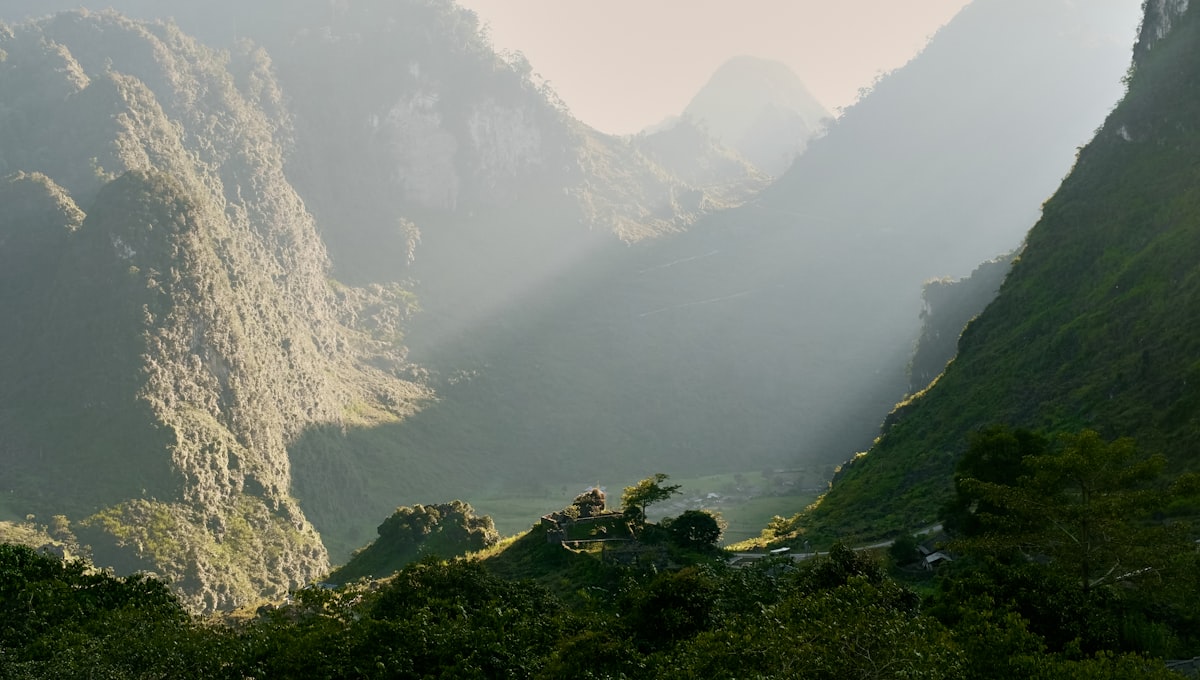
Ha Giang Loop: Vietnam's Most Spectacular Drive
The Ha Giang Loop is a 300 km circuit through Vietnam's far north, winding past rice terraces carved into near-vertical karst cliffs, through passes so high that clouds sit below the road, and into villages where the Hmong and Dao people have lived for centuries largely undisturbed by the lowland tourist economy. The Ma Pi Leng Pass — a stretch of switchbacks above the Nho Que River — is consistently rated among the most dramatic roads in Asia. It earns that description.
Getting there: Fly to Hanoi (HAN), then take an overnight sleeper bus from My Dinh bus station to Ha Giang city (about 7 hours, around $10). From Ha Giang city, rent a semi-automatic motorbike ($8-12/day) or hire an experienced local "Easy Rider" guide with their own bike ($30-50/day). Most riders do the loop in 3-4 days, with guesthouses in Dong Van, Meo Vac, and Yen Minh along the way.
When to go: October-November for golden rice terraces and clear skies; March-April for mustard flower season. Avoid June-August when the roads get muddy and visibility drops.
Phong Nha: Caves Beyond Imagination
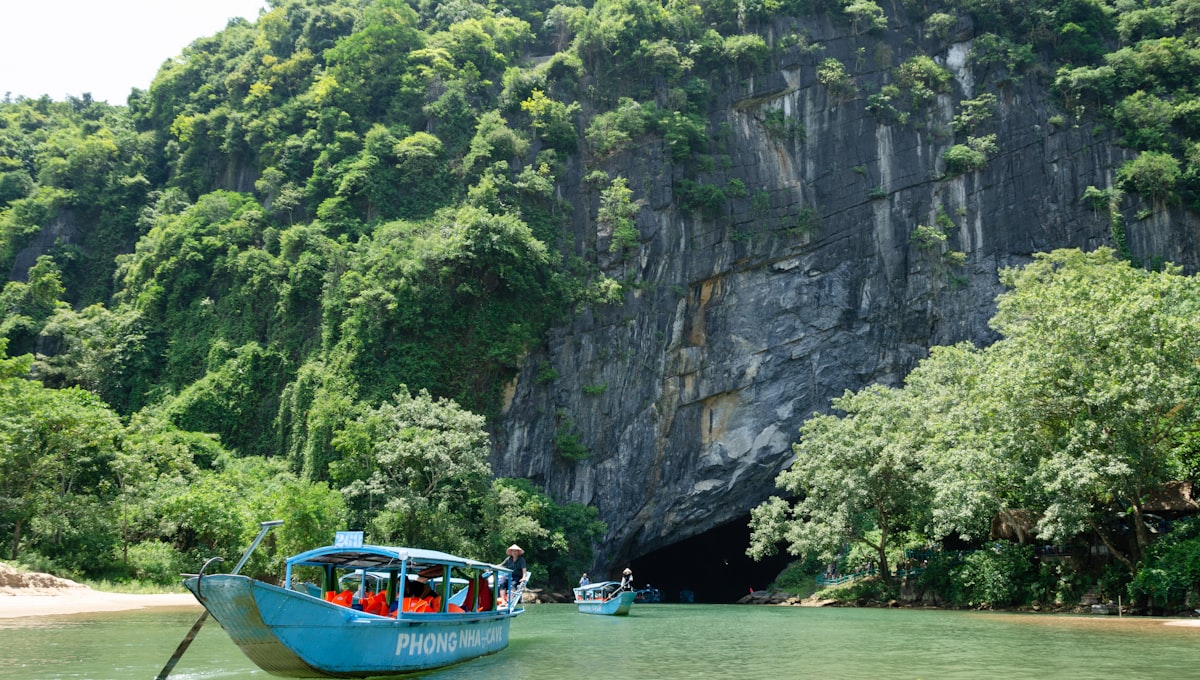
Phong Nha-Ke Bang National Park in Quang Binh province contains the largest cave system on Earth — and most of it is still unexplored. Son Doong, the world's biggest known cave, is big enough to fit a 40-storey skyscraper inside. You can't walk in there without a guided expedition (tours run $3,000+ and book out a year in advance), but the surrounding caves are accessible and extraordinary in their own right.
Paradise Cave (Thien Duong) stretches 31 km underground and is open to casual visitors; the 1 km illuminated section alone takes over an hour to walk through at a slow pace because you keep stopping to look up. Phong Nha Cave is reached by a boat ride up the Son River, which threads into the mountain through a series of stalactite-filled chambers. Dark Cave offers a ziplining entry and a mud bath inside the cave — genuinely good fun rather than gimmicky.
Getting there: Fly to Da Nang (DAD) or Hue (HUI), then take a bus or hire a car north to Phong Nha town (3-4 hours from Da Nang, 2 hours from Hue). Budget accommodation in Phong Nha village runs $15-25/night.
When to go: February-August is the dry season for this part of central Vietnam. Avoid September-November when the region floods badly.
Con Dao Islands: Vietnam Without the Tourists
Con Dao is an archipelago of 16 islands about 230 km off the southern coast. For decades it was synonymous with the notorious Con Dao prison, where both French colonial authorities and later the South Vietnamese government held political prisoners. The history is dark and worth confronting — the museum is one of the most affecting in the country. But Con Dao is also one of Vietnam's last genuinely quiet beach destinations: green turtle nesting sites, coral reefs in decent condition, almost no jet skis or beach bars, and a national park that covers most of the main island.
The town of Con Son has a handful of good restaurants, a night market, and some excellent local seafood. Accommodation ranges from guesthouses at $20/night to the Six Senses resort if you want to spend $800. Most visitors stay in the middle: small boutique guesthouses at $40-80/night.
Getting there: The only practical option is flying. Vietnam Airlines and Bamboo run daily flights from Ho Chi Minh City (SGN) to Con Dao (VCS) — the flight takes 55 minutes and costs roughly $40-70 one-way.
When to go: November-June. July-September brings rough seas and some flights get cancelled. The best diving season is March-June when visibility is highest.
Mai Chau and Pu Luong: Mountain Villages
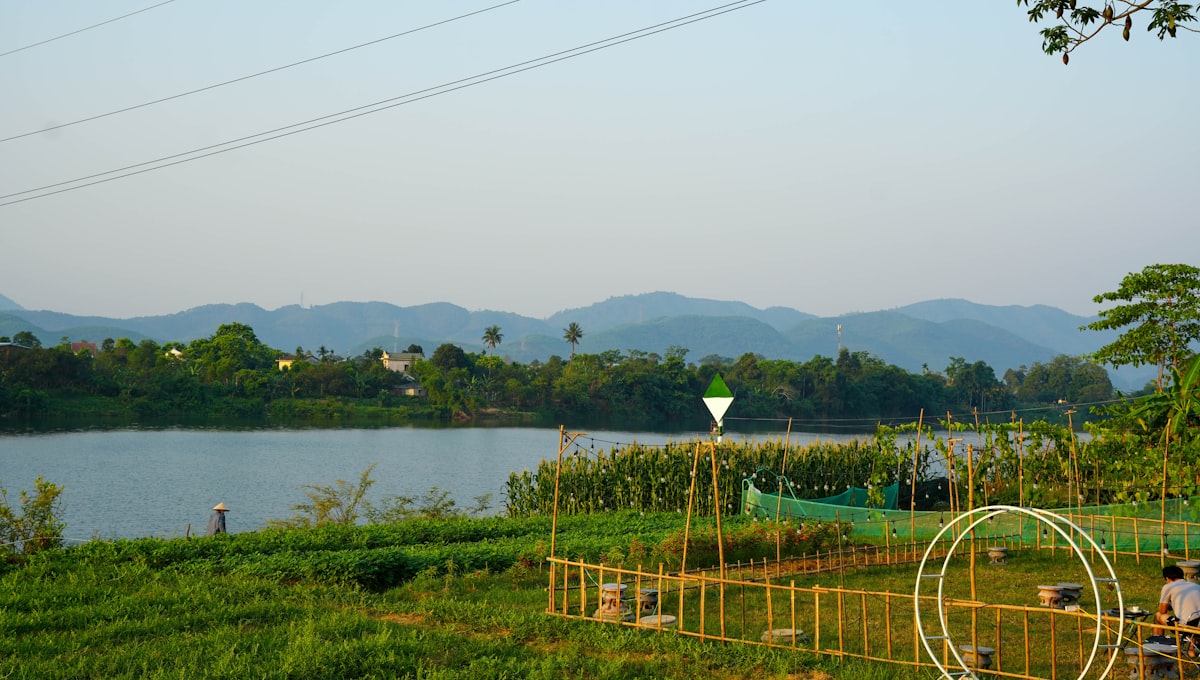
Mai Chau valley, four hours by bus from Hanoi, is one of the most peaceful places in northern Vietnam: a flat valley floor of rice paddies surrounded by limestone hills, dotted with White Thai stilt-house villages where you can stay with a local family for $15-20 a night (including dinner and breakfast).
Pu Luong Nature Reserve, 100 km northeast of Mai Chau, is less visited and arguably more impressive: a narrow valley flanked by twin mountain ranges, with traditional watermills along the river, terraced fields on the hillsides, and a network of trails connecting small Muong villages. Guesthouses here are mostly eco-lodges and homestays — expect $25-45/night with meals.
Getting there: Both are most easily reached from Hanoi. Public buses run from My Dinh bus station to Mai Chau (4 hours, ~$5). For Pu Luong, hire a driver from Hanoi or Mai Chau, or rent a motorbike.
When to go: September-October for harvest season when the terraces turn gold. May-June for the planting season when the paddies are a vivid green.
Quy Nhon: Central Coast's Quiet Beach
Quy Nhon is a mid-sized Vietnamese city on the south-central coast that has somehow avoided being overrun despite having some genuinely good beaches. Ky Co Beach, a 45-minute drive from the city centre, has the kind of turquoise water and white sand that would be plastered across every travel magazine if it were on Koh Samui. Bai Xep is a small fishing village 20 minutes south of the city with clear water and a seafront lined with local restaurants where a bowl of bun ca costs 30,000 VND (about $1.20).
Getting there: Fly direct to Phu Cat Airport (UIH) from Ho Chi Minh City (SGN) or Hanoi (HAN) — flights are typically $35-60 one-way.
When to go: January-August. The south-central coast takes the brunt of typhoon season September-December.
Cat Ba Island: The Alternative to Ha Long Bay
Ha Long Bay is extraordinary — there's no denying that. But it is also extremely crowded, and the budget boat tours that dominate the market have a way of making the experience feel like a floating package holiday. Cat Ba Island, at the southern end of the same bay, is the access point for Lan Ha Bay: the same karst geology, the same emerald water, the same floating fishing villages — and roughly a quarter of the tourist boat traffic.
Cat Ba has a proper town with real infrastructure: motorcycle rental shops, dive operators, a national park with walking trails into the interior, and a population of the critically endangered Cat Ba langur (fewer than 80 individuals remain, making any sighting genuinely rare).
Getting there: From Hanoi, take a bus-and-ferry combination from My Dinh station to Cat Ba town (about 4 hours, $12-18). Budget guesthouses in Cat Ba town run $18-30/night.
When to go: April-October for calm seas and good visibility.
Getting Between Destinations: Transport Practical Guide
Vietnam's length (1,650 km from north to south) means transport choices significantly affect both cost and experience. Here's how each destination connects to the others.
Overnight sleeper trains run the entire north-south corridor from Hanoi to Ho Chi Minh City, with stops at Da Nang, Hue, and several smaller cities. The Reunification Express takes 30-35 hours end to end, but most travelers use it for shorter segments. Hanoi to Da Nang takes around 16-18 hours on a soft sleeper berth (4-berth cabin), costing $25-40 booked through baolau.com or 12go.asia. Hue to Da Nang is a spectacular 2.5-hour coastal ride crossing the Hai Van Pass — cheap, comfortable, and one of the better train journeys in Southeast Asia. Book soft sleeper berths rather than hard sleeper if available; the price difference is small and comfort improves significantly.
Open Bus tickets were the backpacker standard for decades and still work. The Sinh Tourist and Phuong Trang (Futa) bus companies run the full Hanoi–Ho Chi Minh corridor with overnight sleeper buses. Hanoi to Da Nang takes 15-17 hours; Da Nang to Ho Chi Minh City another 18-20 hours. Prices run $12-22 per segment. The trade-off: the buses are slower than trains, often stop at commission-earning tourist agencies, and the overnight experience is less comfortable than a train berth. Use buses for shorter hops (Da Nang to Hoi An, 45 minutes, $2) rather than major overnight segments.
Domestic flights are the answer for anything over 500 km. VietJet Air and Bamboo Airways dominate the budget end; Vietnam Airlines adds a small premium with better luggage allowance. Hanoi to Ho Chi Minh City — the trunk route — runs $35-70 one-way; Ha Noi to Phu Cat (Quy Nhon) $35-55; Ho Chi Minh to Con Dao $40-65. Book through the airlines' own apps — Vietjet especially charges extra through third-party booking engines.
Grab (Southeast Asia's equivalent of Uber) operates in every city in Vietnam and is the fastest way to get from bus/train stations to accommodation. Fares are fixed, transparent, and dramatically cheaper than negotiating with freelance drivers. A typical city crossing costs $1.50-3.
Visa Details
Vietnam's visa situation improved significantly in 2023 and now stands as one of the more straightforward in Southeast Asia for most nationalities.
E-visa: Available to citizens of 80+ countries. Costs $25, processed online at evisa.xuatnhapcanh.gov.vn, takes 3 business days in most cases (sometimes approved within hours). Valid for up to 90 days, multiple entry. This is the right option for nearly all international visitors.
Visa-exempt entry: Citizens of 45 countries qualify for visa-free stays of 30-90 days depending on nationality. Key ones: UK, France, Germany, Italy, Spain (45 days); Japan, South Korea (45 days); Singapore, Thailand (30 days). Check your specific nationality against the current list before assuming — the list has expanded in recent years and may include your passport.
Visa-on-arrival: Technically still available but requires a letter of approval arranged in advance and is more complicated than the e-visa. Not recommended when the e-visa is available and cheaper.
Practical notes: carry a printed copy of your e-visa alongside the digital version. Immigration at smaller airports (Phu Cat, Con Dao) can move slowly; allow extra time. Land crossings from Laos and Cambodia require the e-visa rather than assuming visa-on-arrival is available.
Vietnam Budget Breakdown
Vietnam remains one of the most affordable countries in Asia for budget travelers. Here's what realistic daily spending looks like across spending levels:
Budget traveler ($30-45/day): Hostel dorm or basic guesthouse ($8-18), street food and local restaurants ($5-8), motorbike or public transport ($5-8), one paid attraction per day ($3-8). This is very comfortable by any standard — you're eating well, sleeping decently, and getting around without any financial pressure.
Mid-range traveler ($50-80/day): Decent private guesthouse ($20-35), mix of local and tourist-oriented restaurants ($12-18), some taxis and domestic transport ($10-15), more paid experiences ($8-15). The mid-range level in Vietnam is genuinely excellent value: guesthouses with air-con, hot water, and sometimes a pool; restaurant meals that cost $4-8; tours and activities at a fraction of European prices.
Specific cost anchors: a bowl of pho costs 40,000-70,000 VND ($1.60-2.80) at a proper restaurant; a Hanoi-style bun cha (grilled pork with rice noodles) runs 60,000-80,000 VND; a fresh coconut on the beach is 20,000-30,000 VND; a 333 or Saigon beer in a local bar is 15,000-25,000 VND. The further you get from Hoi An's Ancient Town or Hanoi's Old Quarter, the more prices collapse toward local levels.
Splurge worth making: a cooking class (typically $25-40), a guided cave tour in Phong Nha ($30-50), or a night on a Lan Ha Bay boat cruise ($80-150). These are significantly cheaper than comparable experiences elsewhere in Southeast Asia.
Best Time for Each Destination
Vietnam's weather is complex because the country spans 15 degrees of latitude and has multiple distinct climate zones. There is no single best time to visit Vietnam — it depends entirely on where you're going.
Ha Giang (far north): October-November for golden rice terraces and sharp visibility; March-April for mustard flowers. June-August brings mist, rain, and landslide risk on mountain roads. December-February is cold (near freezing at altitude) and sometimes foggy.
Phong Nha (north-central coast): February-August is the dry window for cave visits. September-November the region floods — some years badly. This is one of the few places in Vietnam that genuinely closes down in wet season.
Con Dao Islands (south): November-June for calm seas and diving visibility. July-September brings rough conditions that cancel flights; October is transitional. Peak diving season is March-June when visibility reaches 20+ metres.
Quy Nhon (south-central coast): January-August. Typhoon season hits September-December with varying intensity depending on the year.
Cat Ba Island (north): May-October for calm seas and jungle hiking. November-January is cold and grey but the island is empty. February-April is warm but can have fog in Ha Long Bay.
The strategic play: if you're travelling for two to three weeks, combine destinations across different climate zones. October-November is the best overall window — Ha Giang and the north are at their most spectacular while the south stays dry and the central coast is finishing its rainy season.
Practical Tips for Off-Beat Travel in Vietnam
Domestic flights are cheap and worth using. VietJet Air, Bamboo Airways, and Vietnam Airlines compete hard on price. Routes like Hanoi-Quy Nhon or Ho Chi Minh-Con Dao regularly come in at $35-60 one-way if you book 1-3 weeks out.
Motorbikes open the country up. A semi-automatic motorbike rents for $8-15/day in most towns. Mountain roads in Ha Giang or the Pu Luong valley are not the place to learn.
Rainy season is regional, not national. The north (Hanoi, Ha Giang) has a wet season from May to September. The centre (Hue, Da Nang, Quy Nhon) floods September-November. The south (Ho Chi Minh, Con Dao) gets rain May-October. You can nearly always find somewhere dry in Vietnam at any time of year.
Book flights across markets to get the best price. Domestic Vietnam Airlines fares often look different depending on which regional version of booking sites you're using — the same principle applies internationally when you're booking your flight into Vietnam. Using a tool like RegionFare to compare prices across 97 markets can save a meaningful amount on the international leg.
 Hidden Gems in South Korea: 6 Places Beyond Seoul